How to Use Proxies with Playwright: A Complete Guide for Web Scraping, Automation, and AI Agents
14 July 2026
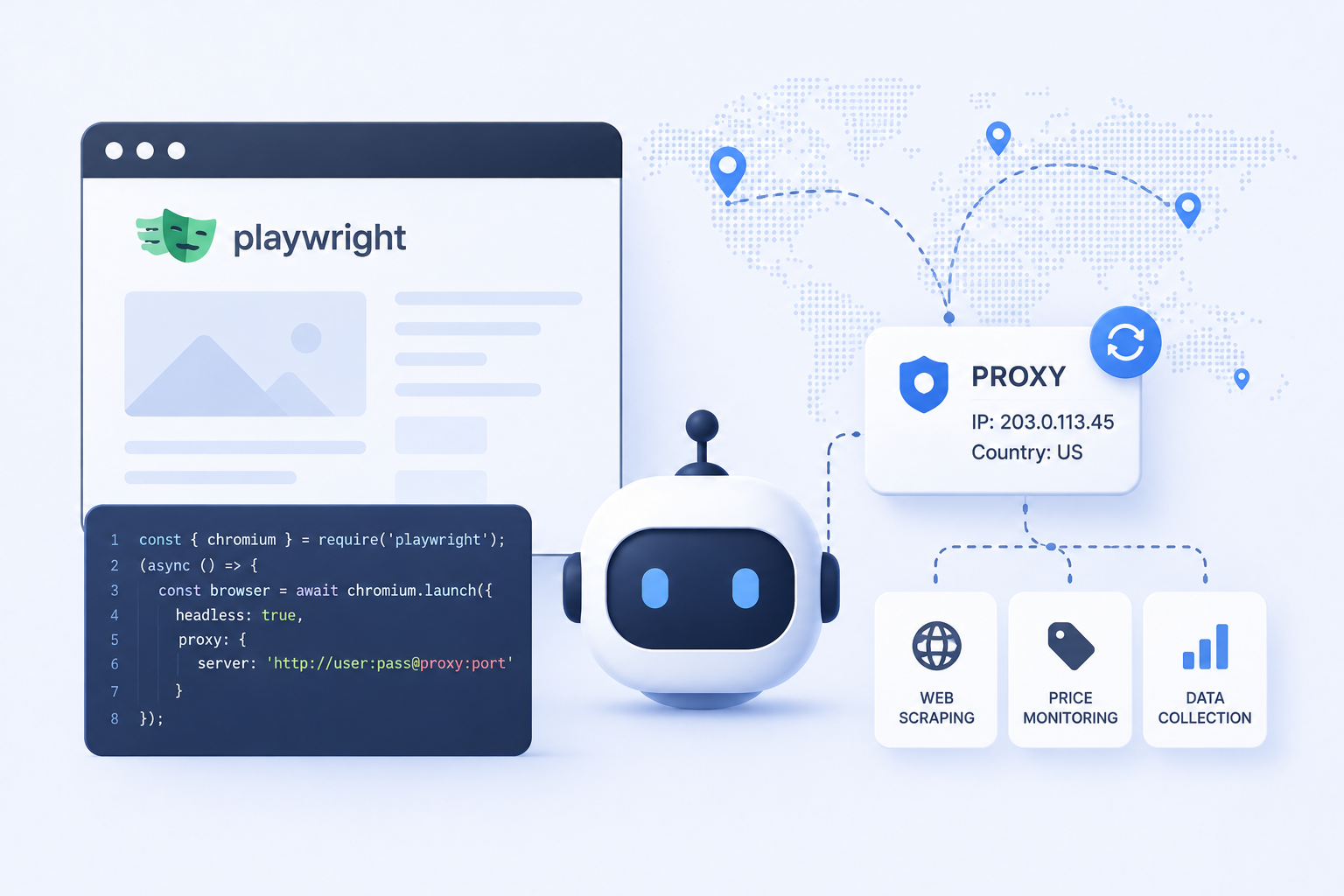
Playwright is a modern open-source browser automation framework developed by Microsoft. It supports Chromium, Firefox, and WebKit, allowing developers to control browsers programmatically through a single API.
Originally designed for automated web application testing, Playwright has evolved into a powerful tool for many other use cases. Today, developers rely on it for web scraping, price monitoring, search engine analysis, product availability checks, business process automation, and building AI agents with internet access.
Thanks to its speed, reliability, and developer-friendly API, Playwright has become one of the most widely used browser automation frameworks available today.
Want to test API proxies before integrating them with Playwright? Sign up for Astro and receive $3 in free credit. That's enough to connect proxies to Playwright, test IP rotation, evaluate connection speed and reliability, and make sure the service meets your needs before purchasing a full plan.
Why Playwright Is Popular for Web Scraping
Modern websites are more complex than ever. Most rely heavily on JavaScript, dynamically load content, and update pages long after the initial request.
Traditional HTTP requests often can’t access this dynamically generated content. Playwright solves this problem by launching a real browser and interacting with websites just like a human user would.
This makes it an excellent choice for a wide variety of tasks, including:
- Data collection
- Price monitoring
- Competitor analysis
- Search engine results monitoring
- Product availability checks
- Browser automation
- AI agent workflows
Because of these capabilities, Playwright has become one of the leading tools for web scraping and browser automation projects.
Why Playwright Needs Proxies
When your application sends only a few dozen requests, you probably won’t encounter any issues.
However, as your project grows, things change quickly.
Imagine scraping thousands of web pages every day, monitoring product prices across multiple online stores, or running hundreds of AI agents simultaneously. If every request comes from the same IP address, websites will likely detect the traffic as automated.
As a result, you may encounter:
- Rate limiting
- Temporary IP bans
- CAPTCHA challenges
- Access restrictions
- Incomplete page loading
- Connection errors
Proxies distribute requests across multiple IP addresses, significantly reducing the risk of these limitations and helping your automation run more reliably.
When Do You Actually Need Proxies?
If your application only sends occasional requests, proxies may not be necessary. However, once you’re scraping multiple websites, automating browsers at scale, or deploying AI agents, proxies become an essential part of your infrastructure.
What Problems Do Proxies Solve?
Many people assume proxies are only used to avoid IP bans. In reality, they provide far more benefits.
With proxies, you can:
- Rotate IP addresses automatically
- Distribute traffic across multiple connections
- Run numerous independent browser sessions
- Access websites from different countries
- Retrieve localized search results
- Monitor regional pricing
- Scale large-scale data collection
- Support growing AI agent deployments
For most enterprise automation projects, proxies are no longer an optional add-on—they’re a core part of the infrastructure.
Which Proxy Types Work Best with Playwright?
There’s no single proxy type that’s ideal for every project.
- Datacenter proxies well suited for applications where the risk of blocking is relatively low.
- Residential proxies use IP addresses assigned to real household internet users. Because they closely resemble normal user traffic, they’re generally the preferred option for web scraping, competitor analysis, and price monitoring.
- Mobile proxies route traffic through mobile carrier networks, making them one of the most reliable options for high-risk automation scenarios.
As projects grow in complexity, many developers move beyond manually managed proxy lists and adopt API proxies instead. Rather than handling IP rotation themselves, they can automate proxy management directly through an API.
Choosing the Right Proxy for Playwright
The best option depends on your specific use case. Datacenter proxies can be sufficient for lightweight automation, while residential and mobile proxies are generally better suited for web scraping, price monitoring, and AI-driven applications. If your infrastructure needs to manage hundreds or thousands of browser sessions, API proxies make scaling significantly easier.
Why API Proxies Are Better Than Traditional Proxy Lists
Small projects can often operate using a static list of proxy servers.
However, once your application launches dozens or even hundreds of browser instances simultaneously, managing those proxies manually becomes increasingly inefficient.
That’s why many development teams switch to API-based proxy management.
API proxies allow applications to request new IP addresses on demand, rotate connections automatically, select specific countries or cities, and manage the entire proxy infrastructure programmatically.
This approach is especially valuable for applications that run continuously without manual intervention.
API Proxies vs. Traditional Proxies
For modern automation projects, API proxies offer a far more efficient solution. They reduce manual configuration, simplify infrastructure management, and make large-scale browser automation significantly easier.
Why API Proxies Matter for Playwright
As automation projects grow, managing proxies manually quickly becomes impractical. Running dozens or hundreds of browser instances requires an efficient way to rotate IP addresses and control proxy settings without constant manual intervention.
API proxies solve this problem by allowing developers to manage proxy infrastructure directly from their applications.
With API proxies, you can:
- Automatically request new IP addresses
- Rotate IPs on demand
- Schedule automatic IP rotation
- Select a specific country, city, or ISP
- Manage proxies without manual configuration
- Scale your infrastructure without changing your application logic
This level of automation is particularly valuable for applications that run continuously and generate large volumes of traffic.
Why This Is Especially Important for AI Agents
Today’s AI agents do much more than generate text. Many can browse the web, search for information, analyze web pages, collect data, and interact with online services.
Playwright is frequently used as the browser automation layer behind these systems.
As the number of AI agents increases, so does the number of requests they generate. When all traffic originates from a single IP address, websites are far more likely to detect and restrict automated activity.
API proxies distribute requests across multiple IP addresses, helping AI agents operate reliably while reducing the risk of rate limits, CAPTCHAs, and IP bans.
For large-scale AI applications, proxy infrastructure is just as important as the AI models themselves.
Astro’s API Proxy Solution for Playwright
Astro provides a fully featured API that allows developers to manage proxies programmatically and integrate IP rotation directly into their applications.
The platform includes:
- Over 50 million IP addresses
- Coverage across 150 countries
- Dynamic residential, mobile, and datacenter proxies
- 99.9% network uptime
- IP rotation on a timer
- IP rotation for every new connection
- Manual IP rotation
- API-based IP rotation
- Country, city, and ISP targeting
- Up to 10 countries on a single port
- Random country selection with the option to exclude up to 10 countries
These features make Astro suitable for both small automation projects and enterprise-scale browser automation.
Why Astro Works Well with Playwright
Common Challenges When Using Playwright
Even well-designed automation projects can encounter restrictions imposed by websites. In most cases, these issues aren’t caused by Playwright itself but by network limitations.
Common challenges include:
- IP bans
- Rate limiting
- CAPTCHA challenges
- Inability to access localized content
- Repeated use of the same IP address
- Reduced scraping performance
A reliable proxy infrastructure helps eliminate most of these problems before they affect production workloads.
Common Problems and How to Solve Them
How to Choose a Proxy Provider for Playwright
When selecting a proxy provider, the size of the IP pool is only one factor to consider.
You should also evaluate:
- A well-documented API
- Automatic IP rotation
- Country and city targeting
- ISP targeting
- Connection stability
- Network speed
- Scalability
- High-quality technical documentation
Choosing a provider with strong automation capabilities from the start makes it much easier to expand your infrastructure as your project grows.
Conclusion
Playwright has become one of the leading frameworks for browser automation, powering web scraping, automated testing, price monitoring, search engine analysis, business process automation, and AI agents.
As projects scale, however, reliable network infrastructure becomes just as important as the automation framework itself. Sending every request through a single IP address can lead to rate limits, CAPTCHAs, and blocked connections.
Proxies distribute traffic across multiple IP addresses, improve access to region-specific content, and make large-scale browser automation significantly more reliable.
Traditional proxy lists may be sufficient for small projects, but API proxies provide a far more scalable solution for applications running hundreds of browser sessions or AI agents.
By integrating Playwright with Astro's API-driven proxy management, developers can automate IP rotation, improve reliability, and build infrastructure that’s ready to scale alongside their applications.


Related questions
-
Proxies distribute requests across multiple IP addresses, reduce the risk of IP bans, provide access to localized content, and improve the reliability of browser automation.
-
Datacenter proxies work well for lightweight automation, while residential and mobile proxies are generally preferred for web scraping, price monitoring, and large-scale automation. API proxies are the best choice for scalable projects.
-
Yes. Small projects with low request volumes can often run without proxies. However, as traffic grows, proxies become essential for avoiding rate limits and IP restrictions.
-
API proxies allow applications to manage proxy servers programmatically. They automate IP rotation, simplify geolocation selection, and make large-scale browser automation much easier.
-
Yes. Playwright supports modern JavaScript-heavy websites, handles dynamic content, and is widely used for web scraping, price monitoring, search engine analysis, and large-scale data collection.
-
Playwright and proxies can be used for web scraping, price monitoring, competitor research, search engine analysis, product availability checks, browser automation, and AI agent workflows.
-
API proxies distribute requests across multiple IP addresses, helping AI agents avoid rate limits, reduce the risk of IP bans, and maintain reliable access to online services.
-
Consider the size of the IP pool, API availability, automatic IP rotation, country and city targeting, ISP targeting, connection speed, reliability, and scalability.
-
Yes. Astro provides an API for automated proxy management, supports dynamic residential, mobile, and datacenter proxies, and offers flexible IP rotation and geolocation targeting for Playwright projects.
-
Yes. API proxies automate IP management, simplify large-scale browser automation, and make it easier to run hundreds or thousands of concurrent Playwright sessions reliably.