Dynamic vs. Static Proxies: What’s the Difference and Which Should You Choose?
22 July 2026
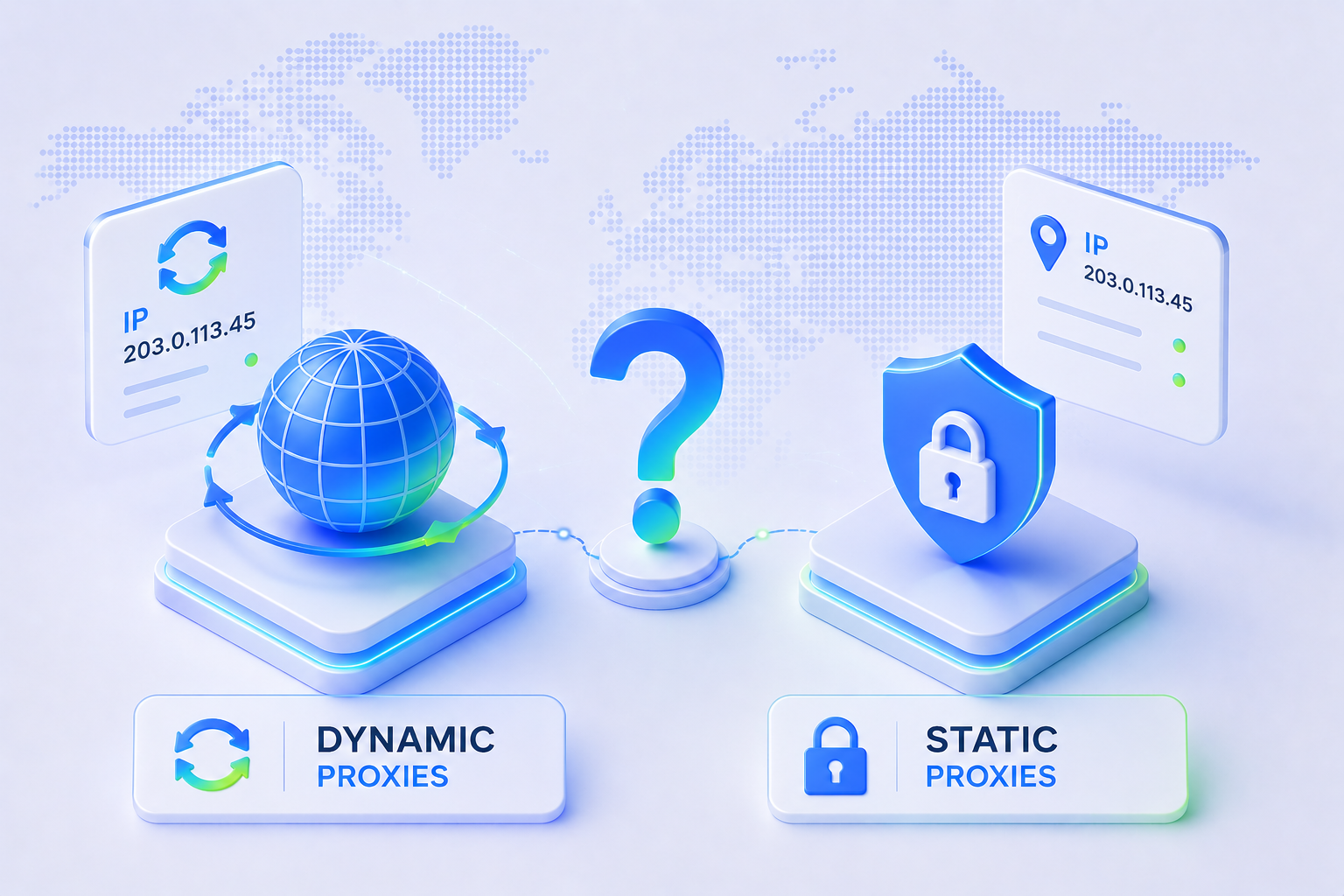
When choosing a proxy service, many users face the question: which is better – dynamic or static proxies? At first glance, it may seem that a permanent IP address is always the more reliable option. However, modern requirements for security, automation, and working with online services have changed the rules of the game.
In this article, we'll explain the differences between dynamic and static proxies, discuss which option is best suited for different tasks, and show why, in most modern use cases, dynamic proxies are the more effective choice.
🎁 Try Astro Dynamic Proxies for Free
Still not sure whether dynamic proxies are right for you? Sign up for Astro and get $3 added to your balance through our support team. That's enough to test the service yourself and choose the IP rotation mode that best fits your needs.
What Are Dynamic and Static Proxies?
Before comparing the advantages of different proxy types, it's important to understand how they work.
What Are Static Proxies?
Static proxies use the same IP address for the entire duration of use. Unless the user manually changes the proxy or purchases another IP address, all connections are made through the same IP.
This option is suitable for tasks where a permanent IP address is required. For example, when access to a server or corporate system is allowed only from a pre-approved IP address.
However, static proxies also have a drawback: all activity gradually accumulates on a single IP address. If a large number of repetitive actions are performed through it, its reputation may deteriorate over time.
What Are Dynamic Proxies?
Dynamic proxies allow you to change your IP address regularly without purchasing a new proxy or manually changing your connection settings.
Your IP can be rotated automatically at a specified interval, with every new connection, or manually whenever needed.
As a result, traffic is distributed across a large pool of IP addresses, making your workflow much more flexible. That's why dynamic proxies are widely used today for automation, multi-account management, web scraping, social media marketing, antidetect browsers, and other tasks where regular IP rotation is important.
Key Differences Between Dynamic and Static Proxies
Although both proxy types serve the same basic purpose, there are several fundamental differences between them.
The main difference is not just IP rotation. More importantly, it's how modern online platforms evaluate user activity.
Why a Static IP Is No Longer an Advantage
Just a few years ago, using a single static IP address was considered the most natural approach. Today, that assumption is gradually becoming outdated.
Modern anti-fraud systems analyze far more than just your IP address. They also evaluate a wide range of additional parameters, including:
- browser fingerprint;
- cookies;
- browsing history;
- the speed of user actions;
- Internet service provider (ASN);
- geographic location;
- behavioral patterns;
- IP usage history;
- and dozens of other technical characteristics.
A static IP address alone no longer makes a user appear more trustworthy. On the contrary, if hundreds of registrations, posts, requests, or other repetitive actions are performed through the same IP every day, that address gradually builds a history of activity, which may increase the likelihood of additional verification or restrictions.
Dynamic proxies help avoid this issue by rotating IP addresses on a regular basis. Instead of concentrating all activity on a single IP, the traffic is distributed across a large pool of addresses, making online activity more flexible and natural.
Why Dynamic Proxies Are Better for Most Tasks
The main advantage of dynamic proxies is the ability to control IP rotation based on your specific workflow.
If one IP address is no longer suitable for a particular task, it can be replaced quickly without purchasing a new proxy. This is especially important for large-scale projects where dozens or even hundreds of simultaneous connections are used. Choosing dynamic proxies can also help optimize your budget and reduce overall costs.
In addition, dynamic proxies allow you to:
- rotate your IP address regularly;
- avoid building a reputation on a single IP address;
- distribute traffic flexibly across multiple IP addresses;
- scale projects without constantly purchasing new proxies;
- automate IP rotation.
That's why dynamic proxies are now the preferred choice for professionals working with automation, web scraping, multi-account management, and antidetect browsers.
Where Dynamic Proxies Deliver the Best Results
The ability to rotate IP addresses regularly makes dynamic proxies the optimal solution for most modern online tasks. They provide greater flexibility when managing connections, distribute traffic across multiple IP addresses, and support projects that require a large number of simultaneous connections.
Dynamic proxies are most commonly used for:
- multi-account management;
- working with antidetect browsers;
- web scraping and data collection;
- automation;
- social media marketing (SMM);
- traffic arbitrage;
- account registration and warm-up;
- price monitoring;
- ad verification;
- marketplace management;
- SEO tasks;
- e-commerce.
In all of these scenarios, the ability to quickly change your IP address is far more valuable than using the same static IP.
When Static Proxies Are Actually Necessary
Despite all the advantages of dynamic proxies, there are situations where a static IP address is genuinely the better option.
For example:
- remote access to a corporate network;
- connecting to a work server;
- systems that allow access only from trusted IP addresses;
- corporate VPNs and internal company services.
Many organizations use what's known as an IP whitelist. This is a list of pre-approved IP addresses that are allowed to connect to a specific server, database, or corporate system. If your IP address is not on that list, access will be denied automatically, even if you enter the correct username and password.
In this situation, dynamic proxies are not suitable because the IP address changes regularly. After every rotation, the new IP would have to be added to the whitelist again, which is often inconvenient or simply impossible. That's why static proxies with a permanent IP address are typically used for these scenarios.
For virtually everything else – multi-account management, automation, web scraping, antidetect browsers, social media marketing, and most other online tasks – dynamic proxies are the more flexible, convenient, and efficient solution.
Dynamic vs. Static Proxies: A Detailed Comparison
When comparing dynamic and static proxies across the key criteria, it becomes clear why more and more users are choosing dynamic proxies today.
As the comparison shows, static proxies remain the best solution for specialized corporate environments where a single, permanent IP address is required.
How Astro Dynamic Proxies Work
Astro specializes exclusively in dynamic proxies because they best meet the requirements of modern online services and provide the flexibility needed for virtually any use case.
Why Choose Astro Dynamic Proxies
Astro is a proxy infrastructure built specifically for projects that require scalability, stability, and flexible IP management.
Users get access to:
- more than 50 million IP addresses;
- coverage across 150 countries;
- country, city, and ISP targeting;
- up to 10 countries on a single port;
- a random country mode;
- 99.9% uptime;
- dynamic residential, mobile, and datacenter proxies;
- a convenient API for automatic IP rotation management.
This feature set makes it easy to build the right proxy configuration for both small projects and large-scale automation systems.
Which Should You Choose: Dynamic or Static Proxies?
To make your decision easier, here's a comparison based on different use cases.
Conclusion
Choosing between dynamic and static proxies always depends on your specific use case. However, for multi-account management, automation, web scraping, social media marketing, data collection, and antidetect browsers, dynamic proxies are the more effective solution in most situations.
Regular IP rotation distributes traffic across multiple addresses, prevents all activity from being tied to a single IP, and makes it easier to adapt to the requirements of modern anti-fraud systems. That's why dynamic proxies have become the standard choice for professionals working with online services.
Astro provides dynamic residential, mobile, and datacenter proxies backed by a pool of more than 50 million IP addresses across 150 countries. Users can choose from three convenient IP rotation modes: automatic timer-based rotation (starting from 1 minute), a new IP with every connection, and manual rotation through the dashboard, a dedicated link, or the API. This allows you to choose the optimal setup for virtually any use case, from small projects to large-scale automation systems.
Whether you're working in social media marketing, automation, data analysis, e-commerce, or managing dozens of accounts at once, Astro lets you choose the IP rotation mode that best fits your needs and provides a stable, scalable proxy infrastructure with minimal limitations.


Related questions
-
For most modern use cases, dynamic proxies are a more flexible and universal solution. They allow users to regularly change IP addresses, support different rotation modes, and are suitable for automation, web scraping, multi-accounting, anti-detect browsers, and many other scenarios. Static proxies are mainly used when a single permanent IP address is required.
-
The main difference is how IP addresses are managed. Static proxies use the same permanent IP address, while dynamic proxies allow users to automatically or manually change IP addresses without purchasing a new proxy.
-
Dynamic proxies are widely used for web scraping, data collection, multi-accounting, SMM, account registration, automation, ad verification, price monitoring, SEO, e-commerce, and working with anti-detect browsers.
-
Static proxies are suitable for connecting to corporate networks, servers, and systems that use an IP Whitelist or require a permanent IP address.
-
Regular IP rotation helps distribute activity across multiple IP addresses instead of concentrating it on a single IP. This makes network management more flexible when performing large numbers of online operations.
-
IP rotation is the process of automatically or manually changing an IP address during a proxy session. It allows users to access different IP addresses without purchasing new proxies.
-
Astro supports automatic IP rotation by timer (from 1 minute), a new IP address on every new connection, manual IP changes through the dashboard or a dedicated link, and automated rotation management via API.
-
Yes. Thanks to regular IP rotation, dynamic proxies are widely used with anti-detect browsers for managing multiple accounts and maintaining flexible network configurations.
-
Yes. This is one of the main advantages of dynamic proxies. Users can get a new IP address automatically or manually without purchasing a new proxy.
-
Dynamic proxies allow businesses to scale projects, automate workflows, quickly change IP addresses, manage connections more efficiently, and choose the most suitable rotation method for different tasks. This makes them an optimal solution for most modern online activities.