UniMessenger and Astro: Automating Messaging Across Multiple Accounts
20 July 2026

With a small recipient database, messages can be sent manually. However, as the number of recipients and accounts grows, you have to constantly switch between devices, monitor limits, keep track of processed contacts, and review the results.
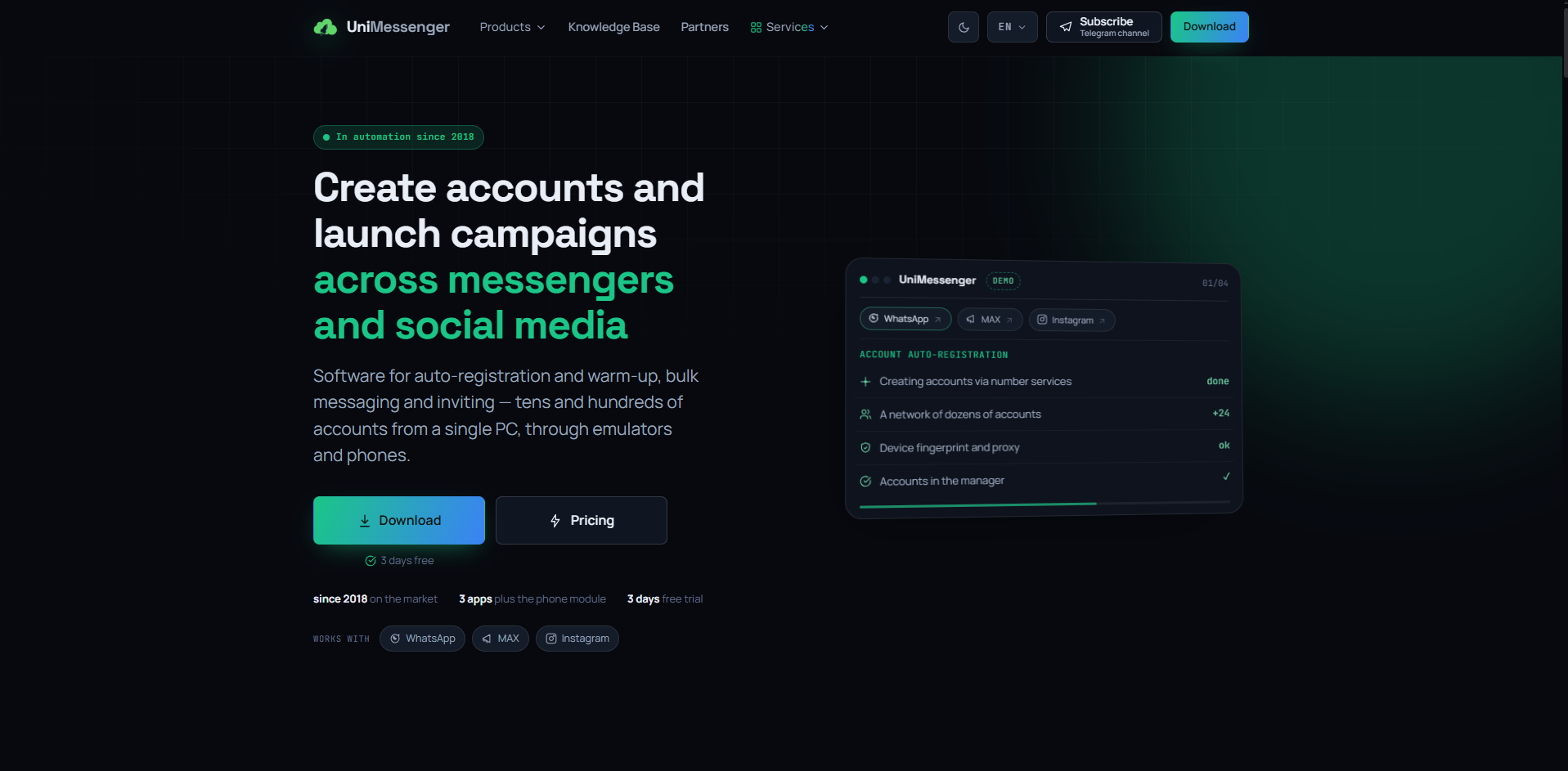
UniMessenger is a suite of tools for automating WhatsApp, MAX, and Instagram through Android emulators and physical phones. It allows users to manage multiple accounts from a single interface, run messaging campaigns and other tasks, configure limits, and monitor execution. All program features are available during a free 3-day trial.
Why use multiple accounts?
One account may not be enough to process a large recipient database. When several accounts participate in a task, UniMessenger distributes contacts among them and runs actions in parallel.
This reduces processing time, allows separate limits to be set for each account, and makes it possible to divide accounts by purpose. If one device is temporarily unavailable, the remaining devices can continue processing the database.
Platform rules, account history, database quality, and action speed must still be taken into account. Simply increasing the number of accounts does not guarantee stable operation.
What can UniMessenger automate?
Available features depend on the selected product.
UniMessenger for WhatsApp is designed for messaging by phone number and in groups, checking whether numbers are registered on WhatsApp, warming up and registering accounts, processing incoming messages, and using automatic replies. Tasks can run simultaneously through multiple emulators or physical phones.
UniMessenger MAX is used for messaging by phone number, user ID, and chats in the MAX messenger. It also supports number checking, account registration, collecting members from public chats, inviting users, and running tasks on a schedule.
UniInstagram is primarily intended for account promotion. It can publish posts, Stories, and Reels, send Direct messages, follow and unfollow users, like content, view publications, and leave comments. Separate limits can be configured for different accounts and actions.
In other words, the WhatsApp and MAX products are mainly used for messaging campaigns and audience management in messengers, while UniInstagram focuses on automating promotion and activity on the social network.
How an automated messaging campaign is created
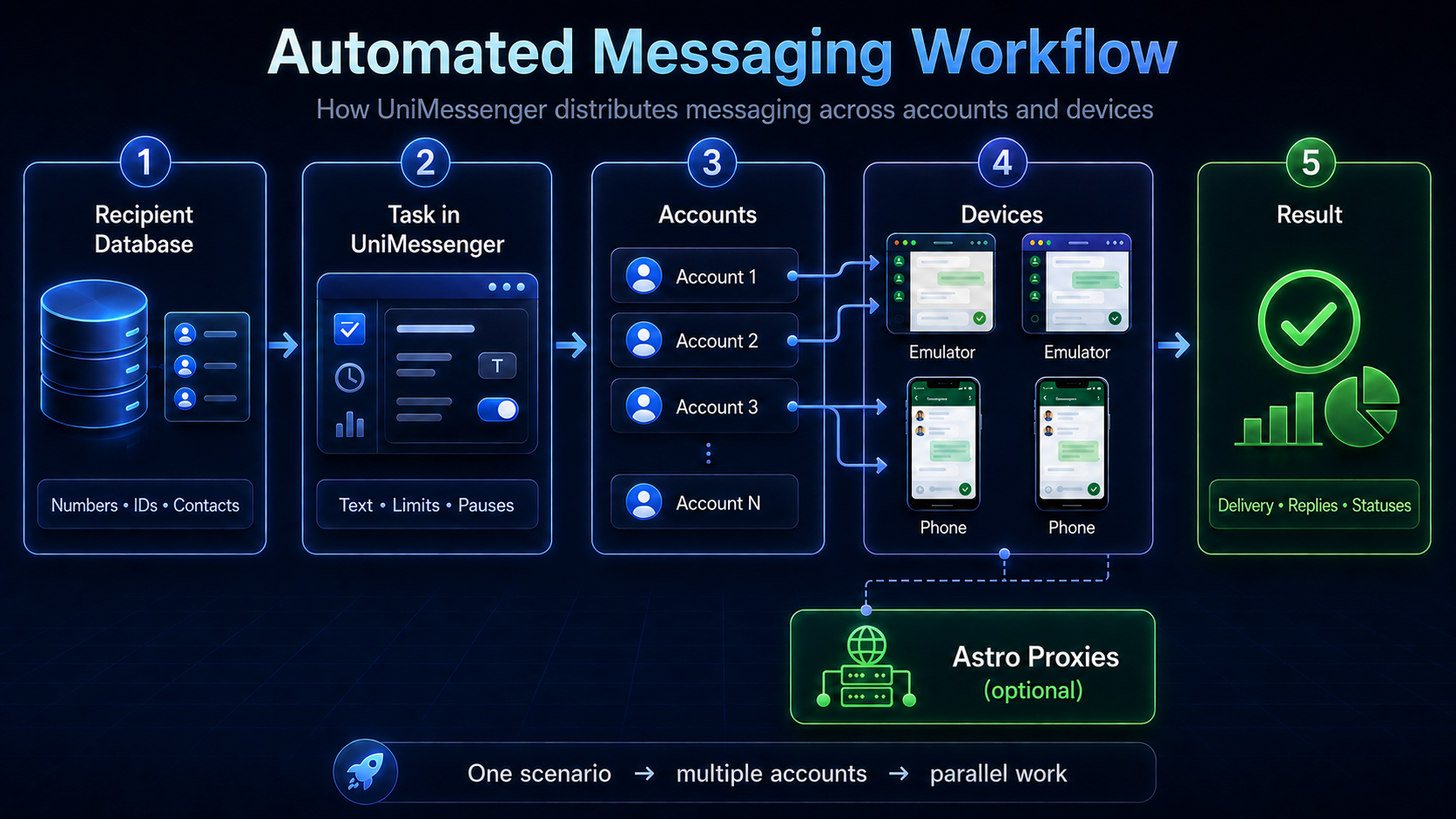
The workflow can be represented as a simple sequence:
number database → UniMessenger task → accounts → devices → proxies, if required → result
First, the database is prepared: duplicates are removed, number formats are checked, and previously processed contacts are excluded. Commercial messages should only be sent to a legally obtained database, taking recipient consent into account.
Accounts are then linked to devices. The usual principle is: one account — one phone or one separate Android emulator instance. UniMessenger supports both emulators and physical Android devices.
The user uploads the database, selects accounts, adds message text and attachments, configures pauses and limits, and sets a schedule when necessary. After launch, the program distributes recipients among the accounts and performs the configured actions.
Why proxies are used with multiple accounts
If all devices are connected to the same network, their activity comes from a single IP address. This may not cause problems when only a few accounts are used, but connections are often separated when scaling to reduce the risk of restrictions.
A proxy routes device traffic through another IP address. It can be used during account registration, warming, and messaging campaigns. A proxy can also be assigned to a specific account or a group of devices.
There is no universal setup for every task. In some cases, one mobile proxy with IP rotation is enough. In others, accounts are distributed across several connections. These scenarios are covered in more detail in the article “When and why to use proxies”.
Proxies do not provide complete protection against restrictions. Platforms evaluate not only the IP address, but also action speed, account history, message content, device parameters, and user complaints.
Astro mobile proxies and UniMessenger
Astro mobile proxies can be used when working with multiple accounts. They route traffic through mobile carrier IP addresses and support IP changes according to configured rules.
The user creates a connection in the Astro dashboard and receives the proxy credentials. These details are then added to UniMessenger or to an auxiliary application that routes device traffic. The supported file format and connection options are described in the guide “Using proxies in UniMessenger”.
In UniInstagram, proxy settings are configured separately and apply to all automated actions. Detailed instructions are available in “Configuring proxies in UniInstagram”.
How to increase workload gradually
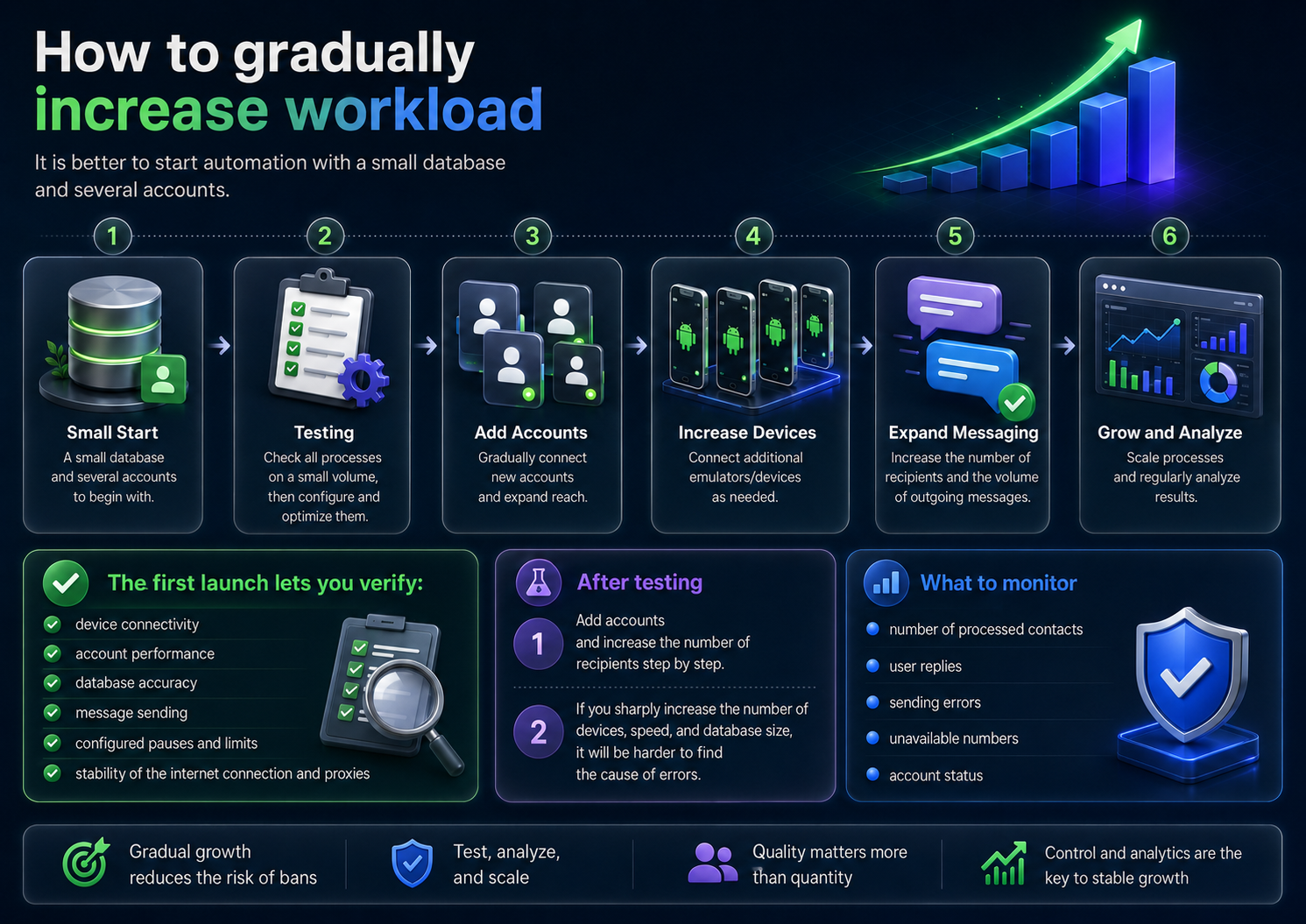
It is better to begin automation with a small database and several accounts. The first launch allows you to test the devices, accounts, database, message delivery, limits, and connection stability.
After testing, you can add more accounts and increase the number of recipients. Parameters should be changed gradually. If you increase the number of devices, speed, and database size at the same time, it will be more difficult to identify the cause of any errors.
You should monitor not only the number of processed contacts, but also user replies, sending errors, unavailable numbers, and account status.


Related questions
-
No. A small number of accounts can usually work through a regular internet connection. Proxies are more commonly used as the number of devices grows and when they need to be distributed across different IP addresses.
-
Yes. One mobile proxy with IP rotation can be used for a group of accounts. Additional connections may be required when many devices work in parallel.
-
No. Proxies help distribute connections, but they do not guarantee account protection. Restrictions are also influenced by account activity, messaging speed, database quality, message content, and recipient complaints.